
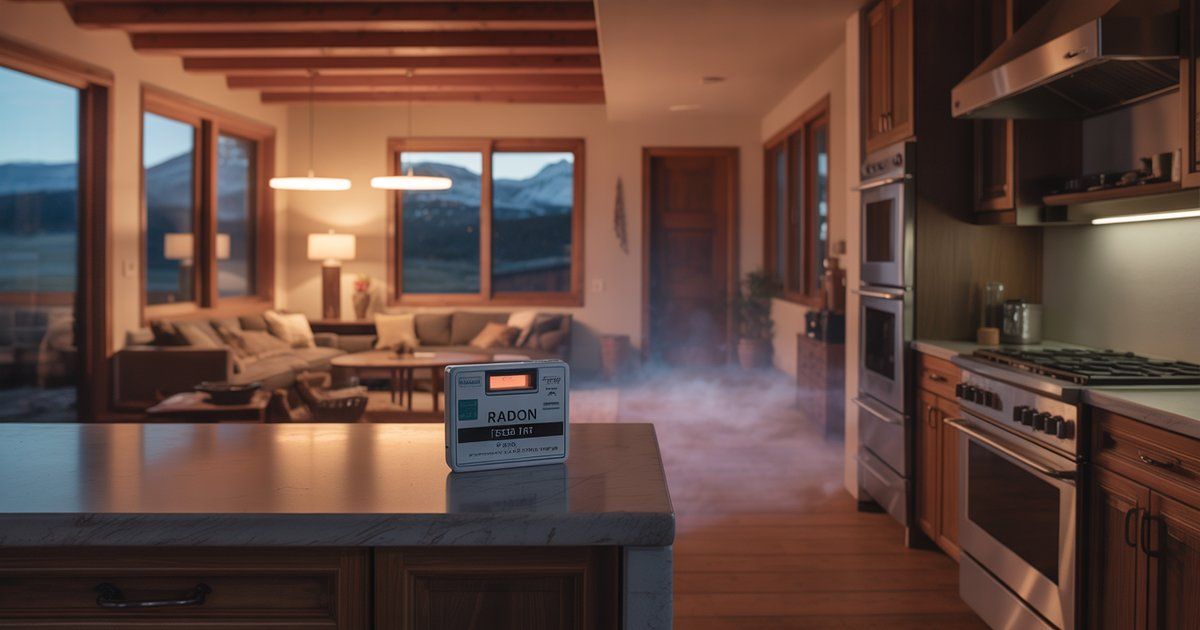
It is in approximately half of Colorado homes. You cannot see it, smell it, or feel it. It is the second leading cause of lung cancer in the United States — behind only smoking. And if you have never tested your home, this issue of The Ascent Clinical Report explains why this week is the time.
Radon is not a weight loss topic. It is a whole-health topic. At Ascent Trim & Wellness, we do not treat your metabolism in isolation from the environment your body operates in. If your indoor air quality is compromised, it affects your recovery, your energy, your cellular function, and ultimately your results.
Radon is a radioactive gas that forms naturally when uranium in soil and rock decays. It seeps into homes through cracks in foundations, basements, slab joints, and crawl spaces. It is odorless, colorless, and undetectable without testing.
Why Colorado is a hotspot: The state’s geology is rich in uranium-bearing rock formations. Colorado Springs’ soil composition and altitude create conditions that promote radon accumulation in enclosed spaces. According to the Colorado Department of Public Health and Environment, approximately half of Colorado homes test above the EPA’s action level of 4 pCi/L (picocuries per liter).
The health risk: Radon is the second leading cause of lung cancer in the United States. The EPA estimates that radon causes approximately 21,000 lung cancer deaths per year. Long-term exposure — particularly in poorly ventilated spaces where you spend the most time (bedrooms, basements, home offices) — significantly increases cumulative risk.
“My neighbor tested low, so I’m fine.” Radon levels vary house to house — even on the same street. Soil composition, foundation construction, ventilation patterns, and seasonal changes all affect individual home levels. Your neighbor’s result has zero predictive value for your home.
“My home is new — it can’t have radon.” Building age is irrelevant. New construction can have radon levels as high or higher than older homes, depending on soil conditions and foundation design. Some newer homes are built “radon-ready” with passive mitigation systems — but these are not universal and do not guarantee safe levels without testing.
“I don’t have a basement.” Radon enters through any point of ground contact: slab-on-grade foundations, crawl spaces, utility penetrations, and even well water. No basement does not mean no radon.
Step 1: Purchase a radon test kit. Available at hardware stores or online for $15–$30. Short-term tests take 2–7 days. Long-term tests (90+ days) provide more accurate annual averages but are not required for initial screening.
Step 2: Follow instructions precisely. Place the test in the lowest lived-in level of your home (basement, first floor, or wherever you spend significant time). Keep windows and exterior doors closed during the test period (except for normal entry and exit). Do not place the test in kitchens, bathrooms, or areas with high airflow.
Step 3: Submit to the lab and review results. If levels are below 4 pCi/L, your home is within the EPA’s acceptable range. If levels are 4 pCi/L or higher, mitigation is recommended. Levels above 8 pCi/L warrant prompt action.
Radon mitigation is neither complicated nor prohibitively expensive. Standard mitigation systems involve a vent pipe and fan assembly that pulls radon from beneath your foundation and vents it above the roofline, combined with sealing of foundation cracks and entry points.
Cost: Typically $800–$2,500, depending on your home’s layout and foundation type. Effectiveness: Professional mitigation systems reduce radon levels by up to 99%. Timeline: Most installations are completed in a single day.
The return on investment for a $15 test that could prevent lung cancer is difficult to overstate.
While radon’s primary health risk is long-term lung cancer, poor indoor air quality compounds the metabolic stressors that patients at Ascent are already managing.
At 6,035 feet, Colorado Springs residents already breathe air with reduced oxygen content. Add radon, volatile organic compounds (VOCs from household products), and inadequate ventilation — particularly in winter when homes are sealed — and the total indoor air quality burden can become significant.
The clinical relevance for weight loss patients: Poor air quality increases oxidative stress and systemic inflammation. Chronic low-grade inflammation directly impedes fat oxidation and promotes cortisol-driven visceral fat storage. Unexplained fatigue, persistent brain fog, and slow recovery that do not respond to sleep optimization or nutrition changes may have an environmental component that deserves investigation.
We are not claiming radon causes weight loss stalls. We are saying that total environmental load matters, and intelligent patients address every variable — not just the obvious ones.
At Ascent Trim & Wellness, we take a whole-body approach to health. The Ascent Shield protects your biology across three layers, but your results also depend on the environment your body operates in.
Ascent Nutritional Architect — Your personalized nutrition blueprint accounts for altitude-specific antioxidant and micronutrient needs that support your body’s defense against oxidative and environmental stress. We do not build cookie-cutter plans. We build plans around your body, your environment, and your goals.
Ascent Collagen Protein Blend — 20g of protein per scoop with functional mushrooms and adaptogens that support immune modulation, cellular resilience, and recovery — particularly relevant for patients managing multiple environmental stressors at altitude.
Physician-supervised NAD+ protocols — NAD+ supports the DNA repair pathways and mitochondrial function that chronic environmental stress (including oxidative damage from poor air quality) degrades over time. Under Dr. Sharma’s oversight, NAD+ supplementation supports the cellular repair infrastructure that keeps your biology resilient.
Ascent Red Light Capsule — Full-body photobiomodulation reduces systemic inflammation and supports mitochondrial ATP production (see Issue #004: Photobiomodulation). When environmental stressors are elevated, maintaining cellular energy output becomes even more critical.
Ascent Body Scanner — 3D body composition tracking provides objective data on how your body is responding to your total protocol — including environmental optimizations. When we see the data shift, we adjust.
Radon is common in Colorado. Testing is cheap. Mitigation works. There is no rational reason not to check.
If you have never tested your home — or it has been more than two years — buy a $15 test kit this week. It takes 15 minutes to set up and could be the most important health decision you make this year.
At Ascent, we help you control every variable we can. Your home air quality is one you can fix today.
At Ascent Trim & Wellness in Colorado Springs, every patient is protected by the Ascent Shield — a physician-supervised, three-layer protocol designed to preserve your health while you lose weight.
Layer 1 — Nutritional Foundation: The Ascent Collagen Protein Blend delivers 20g of protein per scoop with functional mushrooms, adaptogens, and hydrolyzed collagen peptides. Combined with the Ascent Nutritional Architect — a hyper-personalized nutrition blueprint built in real time during your first visit — Layer 1 protects your metabolism and lean tissue from day one.
Layer 2 — Muscle Preservation: Ascent Muscle Form delivers up to 36,000 supramaximal muscle contractions per session, building and preserving the lean muscle mass that GLP-1 therapy alone cannot protect. This is physician-supervised EMS technology, not a retail gym machine.
Layer 3 — Structural Integrity: Ascent Sculpt & Tighten combines radiofrequency, vacuum therapy, and LED to firm skin and tighten tissue as your body changes. Physician-supervised peptide protocols (Sermorelin, NAD+) support cellular repair, hormone optimization, and recovery. Ascent Complete Light Therapy provides full-spectrum photobiomodulation for systemic inflammation reduction and tissue healing.